
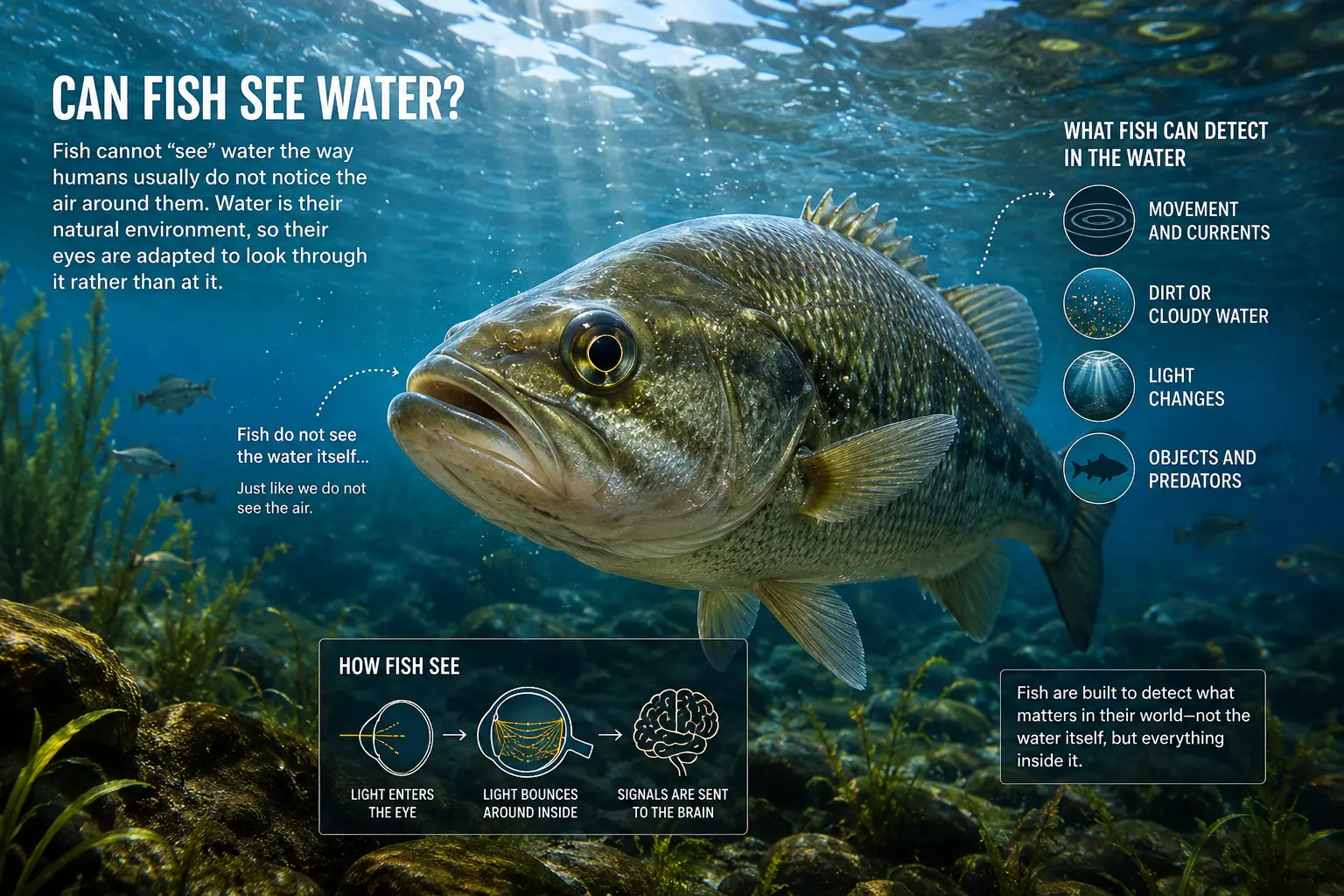
Can Fish See Water? The Science Behind Fish Vision
While swimming in the pool with my eyes open, I noticed that everything underwater appeared blurry. This observation led me to question how fish perceive their underwater environment. To explore this, I consulted with my team member Millen, who possesses greater expertise in fishing.
Millen explained in detail that animals’ eyes are specifically adapted to their respective environments. He noted that human eyes are optimized for vision in air, which accounts for the blurriness experienced when opening our eyes underwater.
Fish Eye Anatomy and Vision
He emphasized that understanding whether fish can see water first requires knowledge of fish eye anatomy. Fish possess highly specialized eyes adapted for underwater life. Although fish and human eyes share fundamental structures, their functions differ due to the distinct environments in which each species lives.
Anatomy of the Fish Cornea
He explained that the human cornea focuses light more strongly than a fish’s cornea because water and the fish cornea have nearly identical densities. As a result, light bends minimally when entering a fish’s eye underwater.
Anatomy of the Fish Lens
He further described the anatomy of the fish lens, noting that fish possess a round, spherical lens that enables clear underwater vision. In contrast, humans have flatter lenses, as our eyes are adapted for air. Fish achieve focus by moving the lens backward and forward, whereas humans focus by altering the shape of the lens.
Anatomy of the Fish Retina
He also explained the anatomy of the retina, which is located at the back of the eye and contains rods and cones responsible for detecting light, movement, and color. Some fish, particularly those inhabiting shallow, clear water, possess excellent color vision.
Difference Between Fish Eyes and Human Eyes
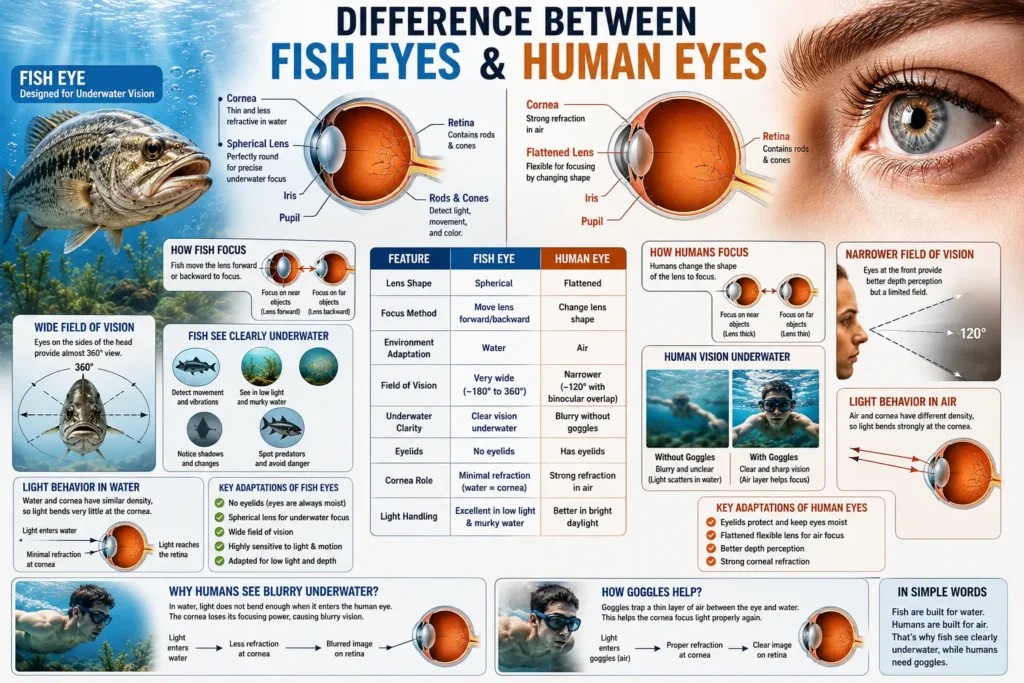
Millen thoroughly explained that fish eyes are specifically adapted for underwater vision, whereas human eyes are designed for optimal vision in air. Consequently, humans typically perceive underwater images as blurry without the aid of goggles.
As previously discussed, human eyes cannot properly focus light in water. In contrast, fish see clearly underwater because their spherical lenses efficiently bend light in aquatic environments.
Another significant difference is the field of vision. Many fish have eyes positioned on the sides of their heads, allowing them to see in nearly all directions, providing a wide field of view. In contrast, humans have forward-facing eyes, which limits peripheral vision but enables precise focus on objects directly ahead.
Can Fish See Water?
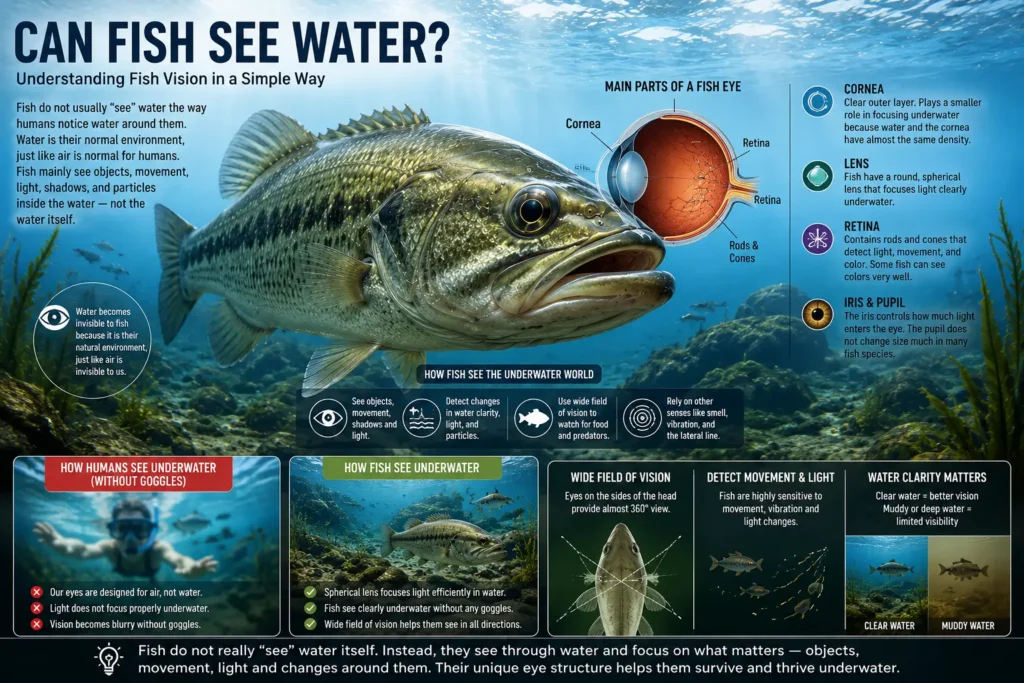
I have often wondered whether fish can perceive water in the same way that humans perceive air. After conducting extensive research and consulting with aquatic experts, I concluded that fish cannot see water. This is because water is their natural environment, just as air is for humans. We do not see air unless it contains smoke or fog; similarly, fish do not see water itself but can detect objects, movement, light, shadows, and other particles within it.
Fish can see effectively in clear water, such as in rivers with crystal-clear conditions. However, muddy or polluted water significantly impairs their vision by limiting visibility.
Fish Senses: How Fish Understand Their Surroundings
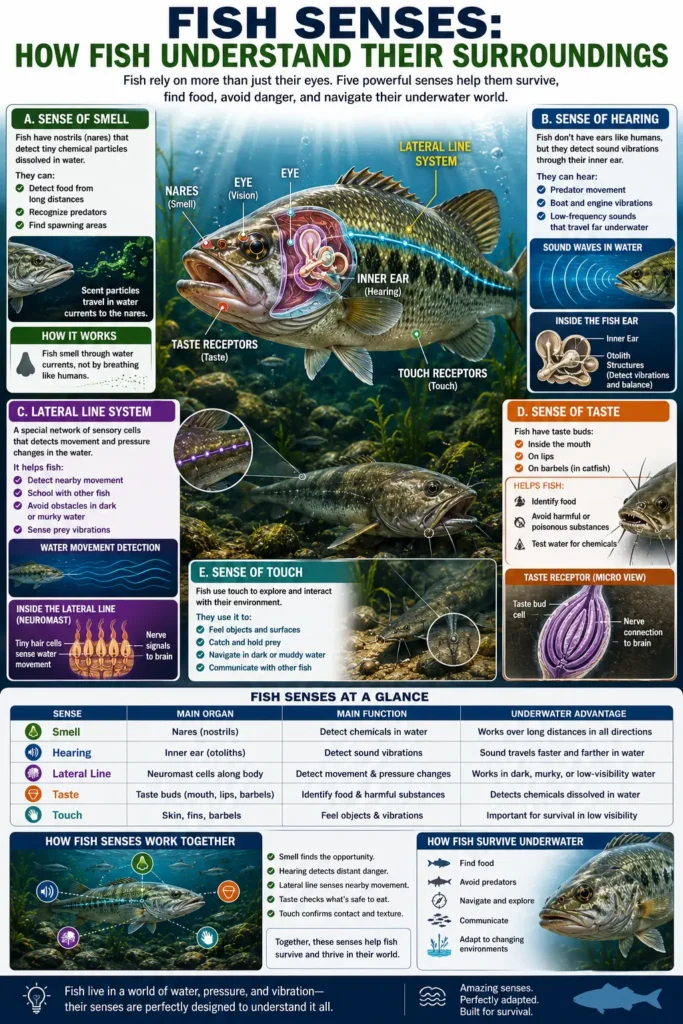
This raises the question of how fish understand their surroundings. Fish rely less on vision than humans do, instead utilizing several other highly developed senses to navigate and survive underwater.
While vision plays a role, most fish also depend on smell, hearing, taste, and vibration detection to locate food, avoid predators, and navigate their environment. These senses are specifically adapted for aquatic life.
Sense of Smell
Fish possess a highly developed sense of smell. As water flows through their nostrils, they can detect minute chemical changes. Many species can identify food, predators, or spawning areas from considerable distances.
Sense of Hearing
Fish detect underwater vibrations and low-frequency sounds through their inner ears. Some species utilize their swim bladder to enhance sound detection. This sense of hearing enables fish to perceive approaching threats and communicate in complex underwater environments.
Lateral Line System
The lateral line system is a distinctive sensory organ that runs along the sides of a fish’s body, detecting water movement and vibrations. This system enables fish to sense nearby motion, coordinate schooling behavior, and avoid obstacles, even in low-visibility conditions.
Sense of Taste
Fish possess taste buds not only in their mouths but also on their lips, barbels, and skin. For example, catfish have taste buds distributed across their skin, enabling them to detect edible substances while swimming. This adaptation allows rapid identification of food before ingestion.
Sense of Touch
Fish are sensitive to touch and changes in water pressure. Their skin and nervous system enable rapid responses to physical contact or environmental changes.
Certain fish species, such as sharks, rays, and skates, possess the ability to detect electric impulses. This sense, absent in humans, assists them in perceiving their surroundings.
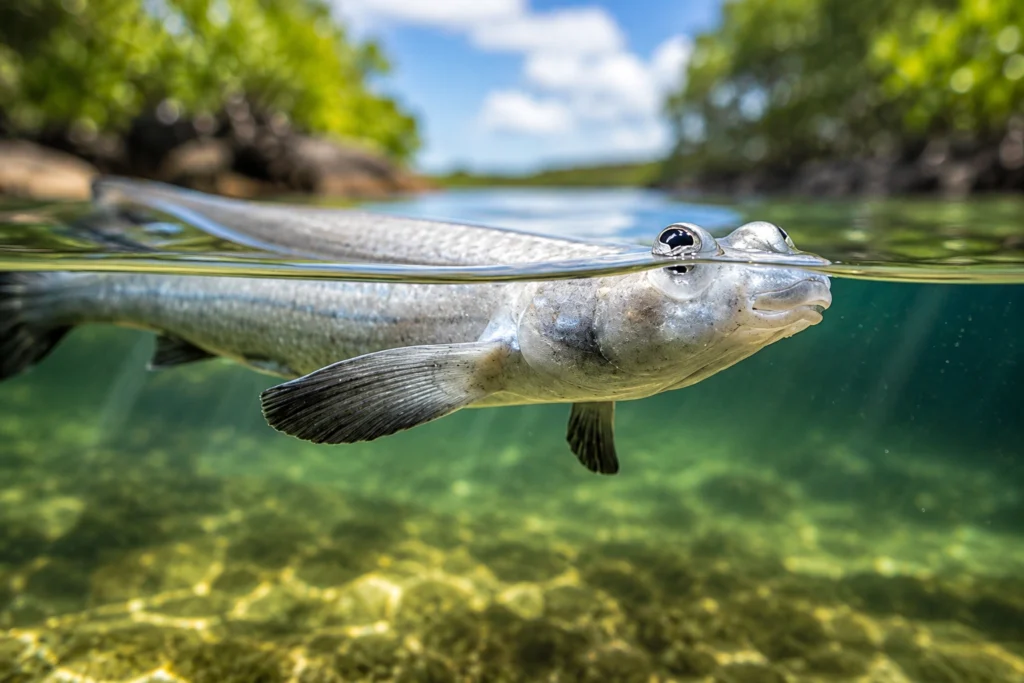
Some species, such as the four-eyed fish, have eyes adapted to view both above and below the water surface simultaneously. This adaptation allows them to monitor two environments at once.
FAQs
Conclusion
In this article, I have presented scientific and expert perspectives on whether fish can see water. The next time you consider how fish perceive water, it is important to understand the anatomy of fish eyes, as explained by my team member Millen. By studying this comprehensive guide, you will be able to answer the question of whether fish can see water with confidence and accuracy.